Basic Electricity and Electronics for Control: Fundamentals and Applications, 3rd Edition

This chapter is a review of some of the common AC sources used in the technical arenas: namely, the function and signal generators. It also provides a generic procedure for calibrating the voltage output of a signal or function generator. To determine alternating voltages or currents correctly, you must use some method for determining the output of the source, and this chapter will familiarize you with one of these procedures.
A signal generator and a function generator both provide AC voltage of different frequency, amplitude, and, in the function generator's case, wave shape. The primary difference is that most signal generators provide a sinusoidal (sine wave-like) output only. The function generator provides a sinusoidal output and, normally, a square wave and a triangular wave output. A function generator may be considered a signal generator with wave shaping. The operation and output calibration procedure of both are similar, and in fact most of these functions today are built into the test equipment used to measure wave shapes, so you will have a source available.
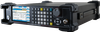
There are many different models of signal and function generators, all with different control panel layouts and even different types of controls. The different models have similar basic functions and procedures for operating.
In the group of frequency-determining controls, modern signal generators and function generators will have a digital arrangement. Many are under software control and are operated from a form of operator interface. They differ widely in appearance, operation, and characteristics. No...