Basic Electricity and Electronics for Control: Fundamentals and Applications, 3rd Edition

Chapter 8: DC Bridges

Bridges are an integral part of measurement and measurement devices. Of the many DC bridges in existence, the Wheatstone bridge is the most often used. One use is to measure unknown resistance values. This chapter explains the operation of the Wheatstone and Kelvin bridges. You must understand bridge operation thoroughly because they are fundamental to many measurements, devices, and techniques. As a plus, they will exercise your understanding of Ohm's Law and its applications.

WHEATSTONE BRIDGE

A bridge is essentially a two-branch balancing network, which is in balance when there is no difference in potential between a point on one branch and the same point on the other branch. The advantage of the bridge's operation lies in the fact that when balance is indicated, the indicator draws no current, a condition called null.

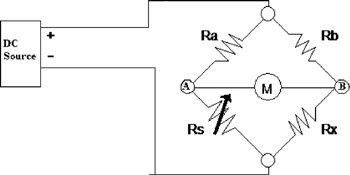
A Wheatstone bridge used to measure resistance is illustrated in Figure 8-1. Ra and Rb in the figure are called the ratio arms. Rs is a variable standard resistance. It has a calibrated scale, so as you vary the resistance the scale tells you the resistance within the accuracy of the scale. Rx is the unknown resistance. Bridges, like the Wheatstone, are used extensively in measurement because they are a comparison measurement, that is, you are comparing an unknown value to a known value, much as in comparison calibration.


Figure 8-1: Wheatstone bridge.

The accuracy of the Wheatstone bridge depends primarily on the tolerance of Ra, Rb,...

UNLIMITED FREE
ACCESS
TO THE WORLD'S BEST IDEAS

SUBMIT
Already a GlobalSpec user? Log in.

This is embarrasing...

An error occurred while processing the form. Please try again in a few minutes.

Customize Your GlobalSpec Experience

Category: Electronic Bridges
Finish!
Privacy Policy

This is embarrasing...

An error occurred while processing the form. Please try again in a few minutes.