Basic Electricity and Electronics for Control: Fundamentals and Applications, 3rd Edition

CHAPTER 7

1.

Determine the total current and total resistance for the following two-resistor combinations in parallel with the source voltage. All resistance is in ohms, and voltage is in volts unless otherwise stated:

  1. R1 = 47, R2 = 22, V = 12.6

  2. R1 = 180, R2 = 120, V = 15

  3. R1 = 1200, R2 = 3900, V = 100

2.

Determine the total resistance using the assumed-voltage method for the following three resistor combinations in parallel with the source. All resistance is in ohms unless otherwise stated.

  1. R1 = 10, R2 = 20, R3 = 5

  2. R1 = 1200, R2 = 2200, R3 = 3900

  3. R1 = 56000, R2 = 47000, R3 = 82000

3.

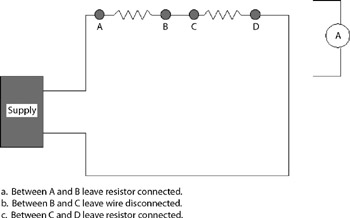
At what point in the circuit shown in the following figure would you connect a current meter?

4.

For this problem, use the following figure. The supply voltage is 25V, Rload is 2.5 kilohms,

Rm (meter resistance) is 50 ohms, and Ifsd (full-scale deflection current) is 500 ?A (.5mA or .0005 amp). If you want fsd to occur at 20mA what value must the shunt be?

5.

Refer to the figure in Problem 4. Rload = 1000, Rm = 50 ohms, and meter fsd is .5mA (.0005A). In this problem, we would like the fsd to occur at 25mA, so what value will Rshunt have?

6.

Refer to the figure in Problem 4. Rload = 2500 ohms, Rm = 100 ohms, and the meter fsd is 1mA. You want fsd to occur...

UNLIMITED FREE
ACCESS
TO THE WORLD'S BEST IDEAS

SUBMIT
Already a GlobalSpec user? Log in.

This is embarrasing...

An error occurred while processing the form. Please try again in a few minutes.

Customize Your GlobalSpec Experience

Category: Voltage Dividers and Voltage References
Finish!
Privacy Policy

This is embarrasing...

An error occurred while processing the form. Please try again in a few minutes.