Basic Electricity and Electronics for Control: Fundamentals and Applications, 3rd Edition

In this chapter you will learn about inductance and capacitance. Many measurement techniques and functions depend on these reactive components. By the end of this chapter, you will have to have a basic understanding of inductance and capacitance and be able to identify their effects. This will enable you to know how, when, and why measurements are made as they are.
Up to a point we have generally discussed measurement in terms of direct current (DC) and Ohm's Law. Alternating current (AC) operates somewhat different than these. There is still no free lunch, yet like life, measurements are not always what they appear to be. Two components of any electrical circuit that only come into play when there is a change (and of course AC is always changing) are capacitance and inductance.
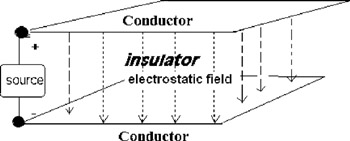
Basically, a capacitance exists between any two conductors that are separated by an insulator. So almost all circuitry has capacitance. If there is a difference in potential between the two conductors, then an electrostatic field will exist between the two through the insulator. Figure 12-1 illustrates this concept.
The greater the difference in potential, the stronger the field. Remember that the electrostatic field is caused by the difference in the number of charges between the conductors. If we moved the two conductors closer together, then the field strength would be stronger because field strength is determined by the square of the distance. For a certain strength field, the closer together the...