Basic Electricity and Electronics for Control: Fundamentals and Applications, 3rd Edition

The oscilloscope is probably the most useful and important piece of test equipment you will use when analyzing the operation of electronic equipment. It is particularly useful in observing AC wave-forms, and that use will be discussed in this text. This chapter explains the block diagram of a simple oscilloscope and briefly outlines some of the generic operations performed with oscilloscopes. Understanding the oscilloscope's various circuit functions will help you to use this amazingly versatile equipment correctly.
The cathode ray tube (CRT) is probably one of the last vacuum tubes still used in new designs. It is the heart of the oscilloscope. Although many newer designs use liquid crystal display or plasma displays, the genesis of the oscilloscope was (and in many cases still is) the CRT.
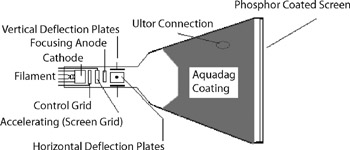
Figure 11-1 shows the general structure of a single-beam oscilloscope CRT.
The CRT consists of the following main parts:
An electron gun assembly consisting of the filament, cathode, control, and accelerating grids. It generates, focuses, and determines the intensity of the electron stream.
Deflection plates, which determine the direction the electron beam will take, hence where it converges on the phosphor screen.
A phosphor-coated screen. On the inside of the faceplate, this phosphor coating phosphoresces (illuminates) at the point the electron stream contacts it. This is observed as a point of light on the outside of the faceplate. The aquadag coating provides the high-voltage attraction for the electron stream and collects the electrons after they...