Basic Electricity and Electronics for Control: Fundamentals and Applications, 3rd Edition

In this chapter, we will build on the concepts you've learned in the preceding chapters and observe how they apply to industrial applications. After all, the purpose of this book is to bring you to the level where you can understand the whys and wherefores of industrial usage.
Understand that the examples in this chapter are a very limited set of those available. The field of measurement and control is application dependent, and there are an infinite number of applications and environments where you will find electric and electronic equipment, so in order to keep the text a reasonable size, only a few examples can be presented. But understanding those presented is very important, they are the basis of many circuits you will find in industry.
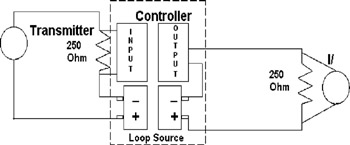
One of the most common circuits you will find in contemporary process control is the two-wire loop. It earned its name because it uses two wires and supplies both the power and the signal on the same lines. In the loop illustrated in Figure 19-1, you can see that there are actually two loops, a measurement loop and an output or control loop.
The transmitter is a constant current device, that is, a device that outputs a current that is determined by external factors and does not vary (within reason) with the voltage across the device. The external factors here would be pressure, level, flow, or temperature, whatever variable you were trying to measure. The loop source