Civil Engineering License Review, Fifteenth Edition
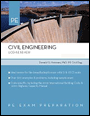
Including essay and multiple-choice exam problems, this review book offers a detailed discussion of the Civil Engineering/Professional Engineer Exam and how to prepare for it.
 TABLE OF CONTENTS
 Mix proportions may be specified either by weight or by volume in terms of the ratios of fine aggregate and coarse aggregate to cement. For example, a 1:3:5 concrete mix consist of three cubic feet (or pounds) of fine aggregate and five cubic feet (or pounds) of coarse aggregate for each cubic foot (or pound) of cement used.
The water-cement ratio of the mix may be specified in terms of either weight or volume. One sack of cement measures one cubic foot and weighs 94 pounds. One gallon of water weighs 8.34 pounds, and one cubic foot of water contains 7.48 gallons. The water-cement ratio is based on the use of saturated surface dry aggregates, and any deficiency or excess of moisture from this value must be allowed for. The free moisture content of the aggregate is given by

where ? = wet bulk density, ? s = saturated surface dry bulk density, and ? = ? s (1 + m).
Fine aggregate, or sand, passes a Number 4 sieve whereas coarse aggregate, or stone, is retained on a Number 4 sieve. Typical properties of the materials used are
| Material | Specific Gravity | Bulk Density |
|---|---|---|
| Cement | 3.1 | 94 |
| Sand | 2.6 | 100 |
| Stone | 2.6 | 95 |
| Water | 1.0 | 62.4 |
The yield of a mix is the volume of concrete produced from one sack of cement and is calculated assuming that all the voids in the sand and stone are filled...