Civil Engineering License Review, Fifteenth Edition

Including essay and multiple-choice exam problems, this review book offers a detailed discussion of the Civil Engineering/Professional Engineer Exam and how to prepare for it.
 TABLE OF CONTENTS
 This chapter treats several aspects of geological science as applied to engineering analysis and design. These subjects are sometimes referred to collectively as soil mechanics. The principles, terms, and calculations in this chapter are essential tools for the practicing civil engineer. Many examples, problems, and solutions are included, along with the principles and explanations, to ensure thorough understanding of the material.
Soils are assemblages of particles of various sizes and shapes with void spaces in between. They are formed primarily from decomposition of rocks. Based on the size of the particles present, soils can be described as gravel, sand, silt, or clay. Following are two grain size classification systems generally used by geo technical engineers:
System of the American Association of State Highway and Transportation Officials (AASHTO)
Gravel: 75 mm to 2 mm
Sand: 2 mm to 0.075 mm
Silt and clay: Less than 0.075 mm
Unified System
Gravel: 76.2 mm to 4.75 mm
Sand: 4.75 mm to 0.075 mm
Silt and clay: Less than 0.075 mm
The particle size distribution in a given soil is determined in the laboratory by sieve analysis and hydrometer analysis.
A typical particle size distribution curve is shown in Fig. 10.1. For classification purposes in coarse-grained soils, the following two parameters can be obtained from a particle size distribution curve:
Uniformity coefficient:

Coefficient of gradation:
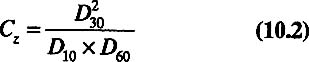
The coefficient of gradation is also sometimes referred to as the coefficient of curvature. The definitions of D 10