Civil Engineering License Review, Fifteenth Edition
Including essay and multiple-choice exam problems, this review book offers a detailed discussion of the Civil Engineering/Professional Engineer Exam and how to prepare for it.
 TABLE OF CONTENTS
 This section provides a brief review of basic terminology, concepts, and procedure related to the timing of traffic signals, specifically pretimed signal systems.
The essential elements that constitute pretimed signal timing are: (1) cycle length (2) interval length, (3) phase duration, (4) phase sequence, and (5) offset of yiel point. Fig. 11.19 illustrates these elements, which are discussed below.
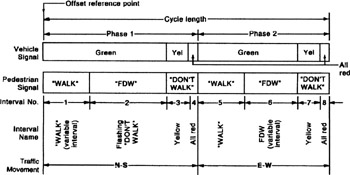
The cycle length is the amount of time for the signal to complete one complet sequence of signal indications. In a coordinated signal system, the cycle length constant for all signals during any given control period. This is true whether the individual controllers are pretimed or actuated.
An interval is the smallest unit of measure used in defining a timing plan and is the segment of the cycle when all signal displays remain constant A phase is a combination of two or more intervals during which the traffic movements given the right of way remain unchanged. A phase is part of a cycle allocated to any combination of traffic movements receiving the right of way simultaneously during one or more intervals.
A signal cycle is composed of as few as two or as many as eight phases, depending upon the traffic movements that require protection during their respective green signal times. A two-phase operation is generally preferable in terms of traffic performance because it permits shorter cycle lengths and more green time for through movements. However,...