Civil Engineering License Review, Fifteenth Edition
Including essay and multiple-choice exam problems, this review book offers a detailed discussion of the Civil Engineering/Professional Engineer Exam and how to prepare for it.
 TABLE OF CONTENTS
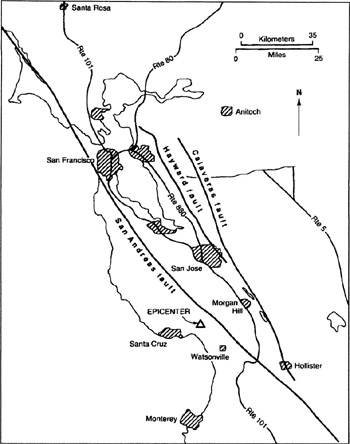
 An earthquake is produced by the sudden rupture or slip of a geological fault. [1], [2] Faults occur at the intersection of two segments of the earth's crust, and along the West Coast of the United States where the boundaries of two large tectonic plates, the Pacific plate and the North American plate, are located. The major fault occurring in California is the 600-mile-long San Andreas fault, a nearly vertical right lateral strike-slip fault, readily identified where it intersects the surface of the earth. The Loma Prieta earthquake of October 1989 occurred on the San Andreas fault, [3], [4] as shown in Fig. 5.1, and the direction of motion [3], [5] is shown in Fig. 5.2.
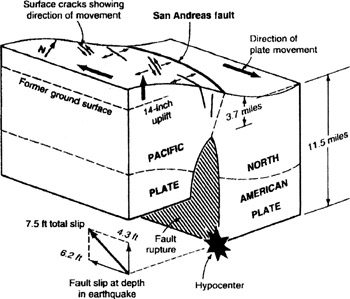
The sudden release of energy at the focus or hypocenter of the earthquake causes seismic waves to propagate through the earth's crust and produces vibrations on the earth's surface. The amplitude of the vibrations diminishes with distance from the epicenter, the point on the earth's surface immediately above the hypocenter, and may last for a few seconds or for more than one minute. Typically, a California earthquake is of short duration, with the Loma Prieta earthquake lasting only eight seconds. Two principal types of seismic waves are generated: body waves, which travel from the hypocenter directly through the earth's lithosphere,...