Civil Engineering License Review, Fifteenth Edition

Including essay and multiple-choice exam problems, this review book offers a detailed discussion of the Civil Engineering/Professional Engineer Exam and how to prepare for it.
 TABLE OF CONTENTS
 Since the number and location of the actual traffic lanes on a bridge deck may be changed during the life of the bridge, design lanes are used to determine the maximum possible loading condition regardless of how the bridge deck width may be demarcated for its initial intended use.
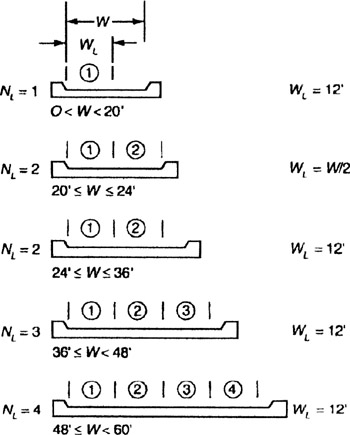
The number of design lanes is defined in AASHTO specifications [1] in Section 3.6. For roadway widths between 20 and 24 feet, two design lanes are adopted, each equal to half the roadway width. For all other roadway widths, the design lanes are specified as being 12 feet wide and the number of design lanes is given by

where
| | integer part of the ratio |
| W = | deck width between curbs |
The location of the design lanes on the deck shall be such as to produce the maximum load effect on the member under consideration.
The determination of the number of design traffic lanes is illustrated in Fig. 3.1.
Vehicular loading is defined in AASHTO Section 3.7. For interstate routes, three load types are specified, and these are the 72-kip HS20-44 standard truck, the equivalent lane load, and the 48-kip alternative tandem loading. These are shown in Fig. 3.2. The standard truck load represents a typical heavy tractor truck with semi-trailer and is generally the critical load type for intermediate-span bridges. For long-span bridges, the multiple presence of vehicles in a design lane...