Classical Electrodynamics, Second Edition
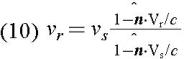
Limits on the "ether wind" have also been set by experiments that rely on the Doppler shift between an emitter of light and a receiver, both in motion. According to Newtonian physics, the Doppler shift depends on the velocities of the emitter and receiver relative to the ether; thus the Doppler shift can be used to detect the "ether wind," if any. Suppose that the emitter and the receiver have velocities V s and V r relative to the ether, respectively; then the received frequency can be expressed in terms of the emitted frequency by the formula
where
is the unit vector perpendicular to the wave fronts of the light.
Derive Eq. (10). [Hint: Show that the frequency ? in the reference frame of the ether is related as follows to the frequencies in the reference frames of the emitter and the receiver:
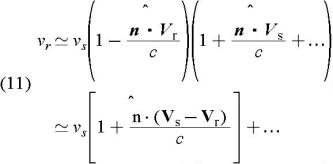
For low velocities, Eq. (10) yields
This shows that the Doppler shift depends mainly on the velocity of the emitter relative to the receiver ( V s ? V r); but it also depends slightly on the velocity relative to the ether, because the direction of propagation
will be altered by the motion of the apparatus (aberration).
The maser experiment of Cedarholm, Bland, Havens, and Townes [13] used a molecular beam with an eastward velocity as emitter. The light, in the form of microwaves, travels northward or southward, perpendicularly away from this beam [the direction...