Classical Electrodynamics, Second Edition

6.5: The Lorentz Transformation

6.5 The Lorentz Transformation

As we know from Section 6.1, in Newtonian spacetime the transformation from one inertial reference frame xt to a second inertial reference frame x ?t ?, moving at velocity V along the x axis of the first, is the Galilean transformation

t ? = t

x ? = x ? Vt

y ? = y

z ? = z

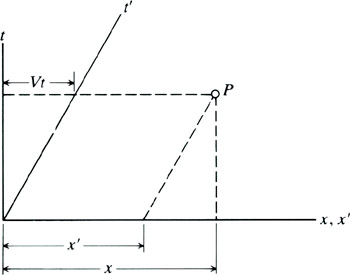
where we have assumed, as usual, that the origins of both sets of coordinates coincide at t = 0. This transformation leaves distance (at a given time) and time intervals invariant. In spacetime, the transformation can be described geometrically as a transformation from rectangular to slanted axes, shown in Fig. 6.9. The x ? axis coincides with the x axis, and the t ? axis coincides with the straight line x = Vt. This means that the t ? axis is the worldline of the origin ( x ? = 0) of the moving reference frame, as it should be.


Figure 6.9: Graphical representation of the Galilean transformation in spacetime. By inspection of the diagram, we see that x ? = x ? Vt.

To find the transformation appropriate to relativistic spacetime, let us begin by plotting the worldine of a light signal emitted at ct = 0, x = 0. Since x = ct for a signal emitted in the positive x

UNLIMITED FREE
ACCESS
TO THE WORLD'S BEST IDEAS

SUBMIT
Already a GlobalSpec user? Log in.

This is embarrasing...

An error occurred while processing the form. Please try again in a few minutes.

Customize Your GlobalSpec Experience

Category: Inertial Sensor Chips
Finish!
Privacy Policy

This is embarrasing...

An error occurred while processing the form. Please try again in a few minutes.