Besides the electric fields generated by static charges, there also exist electric fields generated by time-dependent magnetic fields; these electric fields are called induced fields. In this chapter, we will derive the laws governing induction from Maxwell's equations, and we will work out some examples involving applications of these laws.
By allowing the fields a time dependence, we leave the narrow stage of electrostatics and magnetostatics, and we enter the wide arena of electrodynamics. Not only do time-dependent magnetic fields induce electric fields, but, conversely, time-dependent electric fields induce magnetic fields. These mutual induction effects play a crucial role in electromagnetic waves and in electromagnetic cavity oscillations, topics we will cover in Chapters 12 and 15.
10.1 Faraday's Law of Induction
From Chapter 2, we know that the path integral of an electrostatic field around any closed path is zero. In contrast, the path integral of an induced electric field around a closed path is not zero. This integral is called the electromotive force, or emf, for the closed path. Faraday's law relates the emf for a closed path to the rate of change of magnetic flux intercepted by the area bounded by the path.
For the sake of simplicity, we will first deal with the special case of a stationary closed path. Figure 10.1 shows such a path immersed in an arbitrary, time-dependent magnetic field. The induced emf is defined as
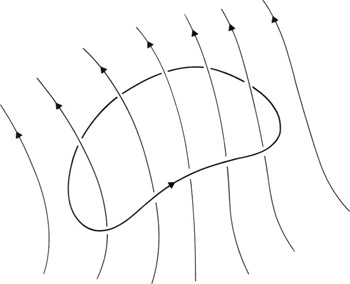 Figure 10.1: A stationary closed path in a time-dependent magnetic field.
 If the path coincides with...
Copyright Infinity Science Press LLC 2007 under license agreement with Books24x7

 TABLE OF CONTENTS