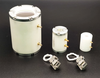
An organ pipe is an example of an acoustic resonant cavity. If we stimulate an organ pipe mechanically, the air column in its interior vibrates. If the frequency of stimulation coincides with one of the eigen-frequencies of the pipe, a standing acoustic wave of large amplitude is excited the pipe resonates.
In this chapter, we will see that any closed container made of a conducting material can serve as an electromagnetic resonant cavity. Electromagnetic waves can be excited in such a cavity by means of a small antenna inserted into the interior. If the frequency coincides with one of the eigenfrequencies of the cavity, a standing electromagnetic wave of large amplitude is excited. If the antenna is removed, the electromagnetic fields continue to oscillate in a cavity made of a perfect conductor, the oscillations would go on forever. In real cavities, the induced electric currents in the cavity walls are subject to ohmic losses, so the electromagnetic energy is gradually dissipated into heat; this means that electromagnetic oscillations are damped by the "friction" of the current in the walls.
We will also examine the propagation of electromagnetic waves in waveguides, that is, long tubes made of a conducting material. The mathematical treatment of waves in such waveguides is quite similar to that of waves in cavities, but instead of standing waves we have to deal with traveling waves.
15.1 Eigenvalue Problem for a Cavity
The problem of electromagnetic cavity oscillations is mathematically much more complicated than the corresponding acoustic problem. We must...
Copyright Infinity Science Press LLC 2007 under license agreement with Books24x7


 TABLE OF CONTENTS