Classical Electrodynamics, Second Edition

Suppose that the reference frame x ?y ?z ?t ? is moving at high speed through the laboratory. How does the rate of the clocks belonging to this reference frame compare with the rate of laboratory clocks?
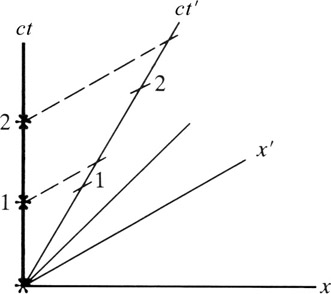
Figure 6.17 shows the axes of the x ?y ?z ?t ? frame and of the laboratory frame, or xyzt frame. A clock at rest in the laboratory has a worldline that coincides with the ct axis. The clock ticks at uniform intervals of one second. Each tick is an event. What is the time interval between these events as measured in the x ?y ?z ?t ? frame? If we draw the slant lines toward the ct ? axis, they intercept the t ? axis above the calibration marks. Hence, as measured by the x ?y ?z ?t ? clocks, the laboratory clock goes slow. From the scale of our diagram, we know that the calibration marks on the ct ? axis differ from the slant-line intercepts by a factor ?. It follows that when the laboratory clock shows an elapsed time ? t, the x ?y ?z ?t ? clocks measure this time as
Another, quicker way to obtain this result is by appeal to the invariance of the spacetime...