In this chapter, we will become acquainted with vector calculus in four-dimensional spacetime. Many of the equations in this chapter are obvious four-dimensional analogs of the three-dimensional equations of Chapter 1. The formalism developed in this chapter will prove very advantageous in expressing relativistic equations of motion for particles or for fields and in expressing relativistic conservation laws of energy and momentum for the collisions and reactions of high-energy particles.
7.1 Four-Vectors and Tensors
In a given inertial reference frame, the coordinates of an event, or space-time point, are ct, x, y, z. The four-components object ( ct, x, y, z) is the position vector of the spacetime point; this is a four-dimensional vector, or a four-vector. It is convenient to introduce the notation ( x 0, x 1, x 2, x 3) for the position four-vector, with
In compact notation, we will often write the position four-vector as
where it is understood that = 0, 1, 2, 3. Note the distinction between the three-dimensional position vector x k of Chapter 1 and the four-dimensional position vector x ? introduced here: the former is written with a Latin superscript, the latter with a Greek superscript.
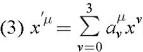
The Lorentz transformation for velocity V along the x axis [see Eqs. (6.34) (6.37)] can now be written as
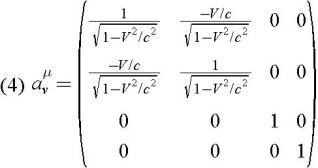
where a ? v is the matrix
Here the first index ( ?) gives the row; the second ( v) gives the column.

 TABLE OF CONTENTS