According to the laws of induction, changing magnetic fields induce electric fields, and conversely. This phenomenon of mutual induction of electric and magnetic fields leads to self-supporting electromagnetic oscillations in space. As we will see, these oscillations take the form of waves propagating with the speed of light. Of course, some initial disturbance is required to start the oscillations. For instance, we might take a point charge and shake it suddenly, starting a disturbance in its electric field; this will then generate an induced magnetic field, which will generate an induced electric field, and so on. The resulting electromagnetic pulse will spread outward from the point charge as a spherical wave. Far from the source of the disturbance, a small portion of such a spherical wave can be approximated as a plane wave. In this chapter, we will study the propagation of plane electromagnetic waves in vacuum and in homogeneous-material media, but we will leave for a later chapter the detailed analysis of how the waves are initiated by sudden changes in the motion of charges.
12.1 Plane Waves in Vacuum
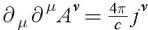
If we describe the electromagnetic field by the four-vector potential, our fundamental field equation is Eq. (8.10),
In vacuum, this becomes
that is,
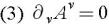
We must supplement this equation with the Lorentz condition, Eq. (8.12),
Equation (2) is a wave equation. Its simplest solutions are plane waves with a harmonic dependence on space and time. For instance, if we assume that the direction of propagation is along the z
Copyright Infinity Science Press LLC 2007 under license agreement with Books24x7

 TABLE OF CONTENTS