Classical Electrodynamics, Second Edition
Chapter 9: Magnetostatics

In the preceding chapter, we discovered that the magnetic field is a relativistic kin of the electric field. Both of these fields are components of the field tensor F ??, and under Lorentz transformations, an electric field can partially metamorphose into a magnetic field, and vice versa. We also discovered the field equations that determine the magnetic fields generated by given currents. In this chapter, we will examine in detail the magnetic fields generated by charges moving with constant velocity and the magnetic fields generated by steady (time-independent) currents. If the current is time independent, then the magnetic field is also time independent. We will see how to calculate such magnetic fields directly from Biot-Savart's law or from Amp re's law and indirectly via the vector potential. And we will see how to calculate the motion of charged particles in a given magnetic field.

9.1 The Magnetic Field of a Point Charge

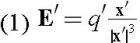
Nothing illustrates the kinship between the electric and magnetic fields more clearly than the calculation we did in Section 8.2 of the magnetic field of a moving point charge. In its own rest frame, or x ?y ?z ?t ? frame, the point charge has only an electric field, the Coulomb field. If the point charge is at the origin,


From this, the Lorentz-transformation equations for the field tensor permit us to find the electric and magnetic fields in the laboratory frame.

According to Eq. (8.47), the resulting magnetic field is


where v

UNLIMITED FREE
ACCESS
TO THE WORLD'S BEST IDEAS

SUBMIT
Already a GlobalSpec user? Log in.

This is embarrasing...

An error occurred while processing the form. Please try again in a few minutes.

Customize Your GlobalSpec Experience

Category: Magnetic Receivers
Finish!
Privacy Policy

This is embarrasing...

An error occurred while processing the form. Please try again in a few minutes.