EC&M's Electrical Calculations Handbook
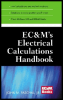
This is user-friendly, example-rich guide to problem solving strategies in engineering, design, installation, cost estimating, lighting design, and maintenance calculations in electrical work.
 TABLE OF CONTENTS
 Just as the 100 pounds (lb) of force that a child exerts when pulling an object toward the east, or x direction, through a rope, cannot be added directly to the 150 lb of force that a separate child exerts simultaneously pulling the same object toward the north, or y direction, the two pulls do work together toward the goal of pulling the object in a direction that is somewhat in the x direction and somewhat in the y direction. The + y direction is depicted in vector geometry as + j, and the ? y direction is depicted as ? j. To resolve the value of the resulting force that is exerted onto the object, vector addition is used.
Vector values are written in two different ways to represent the same values:
Polar coordinates: (100 ? 0 )
Rectangular coordinates: ( 100cos0 + j 100sin0 )
In polar coordinates, the 100-lb pull vector to the right in the x direction would be written as 100 ? 0 , and the 150-lb pull vector to the upward y direction would be written as 150 ? +90 .
A rectangular coordinate vector representation is simply the ( x, y) location on graph paper of the tip of the vector arrow. A polar coordinate can be changed to a rectangular coordinate by the formula

For example, the polar coordinate vector 100