EC&M's Electrical Calculations Handbook
This is user-friendly, example-rich guide to problem solving strategies in engineering, design, installation, cost estimating, lighting design, and maintenance calculations in electrical work.
 TABLE OF CONTENTS
 While almost all ambient temperatures in electrical engineering are given in degrees Fahrenheit, almost all temperatures of equipment operation are stated in degrees Celsius. Therefore, it is important that a quick and easy conversion method be available. Figure 16-1 shows how to make these conversions and provides a quick cross-reference tool from which the conversion can be derived instantly in either direction.
| TEMPERATURE CONVERSION TABLE | |
|---|---|
| C=5/9 (F 32) | |
| F=[(9/5)C]+32 | |
| C | F |
| ?80 | ?112 |
| ?70 | ?94 |
| ?60 | ?76 |
| ?50 | ?58 |
| ?40 | ?40 |
| ?30 | ?22 |
| ?20 | ?4 |
| ?10 | 14 |
| 0 | 32 |
| 10 | 50 |
| 20 | 68 |
| 30 | 86 |
| 40 | 104 |
| 50 | 122 |
| 60 | 140 |
| 70 | 158 |
| 80 | 176 |
| 90 | 194 |
| 100 | 212 |
| 110 | 230 |
| 120 | 248 |
| 130 | 266 |
| 140 | 284 |
| 150 | 302 |
| 160 | 320 |
| 170 | 338 |
| 180 | 356 |
| 190 | 374 |
| 200 | 392 |
| 210 | 410 |
| 220 | 428 |
| 230 | 446 |
| 240 | 464 |
| 250 | 482 |
| 260 | 500 |
| 270 | 518 |
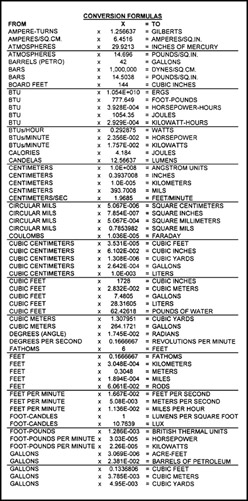
For work in the electrical industry, many other conversion calculations are encountered repeatedly. Figure 16-2 provides the conversion formulas for these common conversions, and Fig. 16-3 is a set of typical sample calculations showing how to use the conversion formulas correctly. Each of these conversion calculations has been changed into a simple one-step calculation for ease of use.