EC&M's Electrical Calculations Handbook
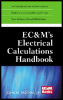
This is user-friendly, example-rich guide to problem solving strategies in engineering, design, installation, cost estimating, lighting design, and maintenance calculations in electrical work.
 TABLE OF CONTENTS
 When the current flow path is directed correctly, the pressure of the source voltage forces normal current magnitudes to flow through the load impedances. During this time, the insulation surrounding the energized conductors prevents current from flowing through any path other than through the load impedance. In this situation, the load impedance is large enough to limit the current flow to "normal" low values in accordance with Ohm's law:

Problems arise, however, when the conductor insulation fails, permitting a shortened path for electron flow than through the load impedance. If the shortened path, or short circuit (also known as a fault), permits contact between a phase conductor and an equipment grounding conductor, this is known as a ground fault, or a phase-to-ground fault. If, however, the shortened path instead permits contact between two or three phase conductors, then it is known as a phase-to-phase fault.
If a solid connection is made between the faulted phase conductor and the other phase wire or the equipment grounding conductor, then the short circuit is identified as a bolted fault. In bolted faults, little or no arcing exists, the voltage drop across the very low impedance of the almost-nonexistent arc is very low, and the fault current is of high magnitude.
If an arcing connection is made between the faulted phase conductor and the other phase wire or the equipment grounding conductor, then the short circuit is identified as an arcing fault, with its associated lowered...