EC&M's Electrical Calculations Handbook
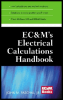
This is user-friendly, example-rich guide to problem solving strategies in engineering, design, installation, cost estimating, lighting design, and maintenance calculations in electrical work.
 TABLE OF CONTENTS
 The work of grounding systems is probably one of the best kept set of secrets in the electrical industry. At first glance, the deceptively simple passive elements of grounding systems obviously could not do very much, or could they? The answer is that grounding systems come in many shapes, forms, and sizes and do many duties, many of which are absolutely essential. If they are designed and constructed well, then the systems they support have a good chance of working well. However, if the grounding system is flawed in design or installation, or if it is damaged by impact or chemical attack, the related systems are negatively affected.
Consider the case of a static grounding grid with its variety of grounding electrode shapes in an industrial plant that is energized through a high-voltage utility substation. This almost completely hidden grounding system performs all these tasks:
It minimizes the ground potential rise and coincident step and touch potentials that occur from high-voltage system zero sequence current flowing through the earth during utility system ground faults, such as insulatorstring arc-over.
It equalizes the direct-current (dc) potentials within the plant that build up from process flows.
It limits the system-to-frame voltage for human safety and prevents overstress in phase-to-ground voltage.
For all practical purposes, it provides an equipotential plane on which humans can stand and not be harmed during times of ground fault within the plant. That is, it equalizes the potential of, say, a motor stator that a...