EC&M's Electrical Calculations Handbook
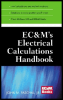
This is user-friendly, example-rich guide to problem solving strategies in engineering, design, installation, cost estimating, lighting design, and maintenance calculations in electrical work.
 TABLE OF CONTENTS
 It is always valuable to keep in mind the definition of a footcandle: It is the quantity of lumens per square foot of illuminated work surface. This definition alone provides the lighting designer a quick rough estimate of the quantity of lumens required to illuminate (fall on) a certain area: Take the footcandle value and multiply it by the area in square feet:
Approximate lumen quantity falling on the area

A more accurate and easy approximation of the actual lamp lumen requirement (how many lumens must be emitted by the lamps within the luminaires) is also possible. Note that some of the lamp lumens are trapped within the fixture and do not reach the area to be illuminated. To provide for this inaccuracy, a determination is made of the rough approximate total quantity of lumens required to illuminate the area; dividing the total lumen requirement by the lumen output from each luminaire (typically one-half the lamp lumens) provides a good estimate of the quantity of luminaires required to illuminate the area. One-half the lamp lumens is a good estimate of the light emitted by each fixture after the combination of luminaire coefficient of use (CU) and light losses is considered:
Approximate lumen quantity emitted by lamps

or, stated in another way,
Approximate lumen quantity emitted by lamps

This quick calculation method is also a good method of checking intensive manual calculations or computer calculations to see if their results are reasonable.
From this basic logic,...