EC&M's Electrical Calculations Handbook
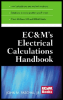
This is user-friendly, example-rich guide to problem solving strategies in engineering, design, installation, cost estimating, lighting design, and maintenance calculations in electrical work.
 TABLE OF CONTENTS
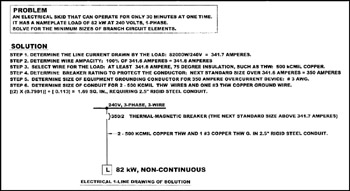
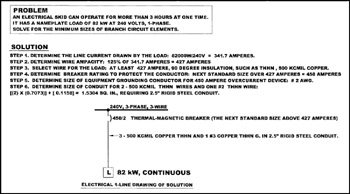
 The normal procedure used to determine circuit sizes and characteristics for typical loads is to determine the wiring method and conductor and insulation types to be used from the installation-site environmental data, solve for the current that will be drawn by the load, select the conductor size, and then determine the raceway size. After all this is completed, a calculation of the voltage drop in the system is normally done to determine that sufficient operating voltage is available at the terminals of the load for it to operate satisfactorily. A solution using this methodology is shown in Fig. 13-1. When the load can operate for 3 hours or longer, it is considered to be a continuous-duty load, and the circuit must be designed for continuous operation. Figure 13-2 is the solution method used for designing the electrical circuit to a continuous load.
There are many types of electrical loads that exhibit special operational characteristics, such as large inrush currents on initial energization. The electrical system must be designed to permit these unique loads to start and operate successfully while still providing protection from abnormal current flow. For example, when starting a motor, a large inrush current flows until the motor can establish a "back emf" to limit line current. The electrical system must...