EC&M's Electrical Calculations Handbook
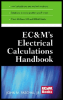
This is user-friendly, example-rich guide to problem solving strategies in engineering, design, installation, cost estimating, lighting design, and maintenance calculations in electrical work.
 TABLE OF CONTENTS
 Conductors are the lifeline of every electrical system, and an electrical system only operates as well as the conductors that connect the power source to the loads. In this chapter, calculations are provided to assist in the selection of conductors.
To calculate either the voltage drop or the heat losses in a conductor, one must first determine the resistance of the conductor. This section provides a method for determining conductor resistance, considering its shape, its length, the material of which it is made, and the temperature at which its resistance is to be determined.
To begin with, Fig. 4-1 shows a table containing physical characteristics and direct-current (dc) resistance at 75 C of American Wire Gauge (AWG) and circular mil conductors, and Fig. 4-2 is a table containing cross-references in wire sizes from AWG to square millimeters, the wire size convention used in International Electrotechnical Commission (IEC) countries and within Australia. The table shows wire sizes that can be calculated using the methodology shown in Fig. 4-3.
| SIZE | AREA | STRANDS | DIAMETER | AREA | DC RESISTANCE | DC RESISTANCE |
|---|---|---|---|---|---|---|
| (AWG OR KCMIL) | (CIRCULAR MILS) | (INCHES) | (SQ.IN.) | AT 75 DEG. C COPPER (uncoated) (OHMS/1000 FT.) | AT 75 DEG. C ALUMINUM (OHMS/1000 FT.) | |
| 18 | 1620 | 1 | 0.040 | 0.001 | 7.77 | 12.8 |
| 18 | 1620 | 7 | 0.046 | 0.002 | 7.95 | 13.1 |
| 16 | 2580 | 1 | 0.051 | 0.002 | 4.89 | 8.05 |
| 16 | 2580 | 7 | 0.058 | 0.003 | 4.99 | 8.21 |
| 14 | 4110 | 1 | 0.064 | 0.003 | 3.07 | 5.06 |