Electrical Properties Of Materials, Seventh Edition
In thermal equilibrium the number of electrons moving towards the left is equal to the number of electrons moving towards the right. However, when a forward bias is applied, the number of electrons poised to move left is increased by a factor, exp eU 1/ kT. This is quite large; for an applied voltage of 0.1 V the exponential factor is about 55 at room temperature. Thus the number of electrons appearing at the boundary of the p-region is 55 times higher than the equilibrium concentration of electrons there.
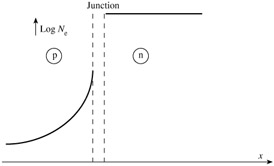
What happens to these electrons? When they move into the p-region they become minority carriers, rather like immigrants travelling to a new country suddenly become foreigners. But, instead of mere political friction, the electrons' ultimate fate is annihilation. They are slain by heroic holes, who themselves perish in the battle. [4] Naturally, to annihilate all the immigrants, time and space are needed; so some of them get quite far inside foreign territory as shown in Fig. 9.6, where the density of electrons is plotted as a function of distance in a p-n junction under forward bias. The electron density declines, but not very rapidly. A typical distance is about 1 mm, which is about a thousand times larger than the width of the transition region.
Let us go back now to the plight of the holes. They are there in the p-type material to neutralize...