Overview
The problem of variational calculus is to find the form of the function y( x) which makes the integral
| (A.1) | 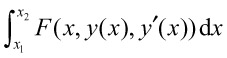
|
an extremum (maximum or minimum), where F is a given function of x, y, and y'.
Assume that y( x) does give the required extremum, and construct a curve y( x) + ?( x) which is very near to y( x) and satisfies the condition ?( x 1) = 0 = ?( x 2). For the new curve our integral modifies to
| (A.2) | 
|
Now making use of the fact that ? and ?' are small, we may expand the integral to the first order, leading to
| (A.3) | 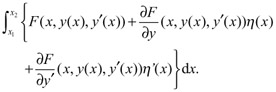
|
Integrating the third term by parts (and dropping the parentheses showing the dependence on the various variables) we get
| (A.4) | 
|
which substituted back into eqn (A.3) gives
| (A.5) | 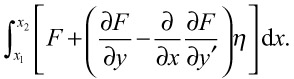
|
We may argue now that y( x) will make the integral an extremum, if the integral remains unchanged for small variations of ?. This will occur when the coefficient of ? vanishes, that is, when
| (A.6) | 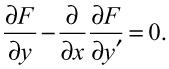
|
The above equation is known as the Euler differential equation, the solution of which gives the required function y( x).
When F depends on another function z( x) as well, an entirely analogous derivation gives one more differential equation in the form
| (A.7) | 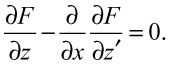
|
These two differential equations, (A.6)...


 TABLE OF CONTENTS