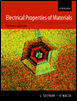
Electrical Properties Of Materials, Seventh Edition
Answers to Exercises

Chapter 1

1.

A 10 mm cube of germanium passes a current of 6.4 mA when 10 mV is applied between two of its parallel faces. Assuming that the charge carriers are electrons that have a mobility of 0.39m 2V -1s -1, calculate the density of carriers. What is their collision time if the electron's effective mass in germanium is 0.12 m 0 where m 0 is the free electron mass?

2.

An electromagnetic wave of free space wavelength 0.5 mm propagates through a piece of indium antimonide that is placed in an axial magnetic field. There is resonant absorption of the electromagnetic wave at a magnetic field, B = 0.323 wb m -2.

  1. What is the effective mass of the particle in question?

  2. Assume that the collision time is 15 times longer (true for electrons around liquid nitrogen temperatures) than in germanium in the previous example. Calculate the mobility.

  3. Is the resonance sharp? What is your criterion?

3.

If both electrons and holes are present the conductivities, add. This is because under the effect of an applied electric field the holes and electrons flow in opposite directions, and a negative charge moving in the (say) + z-direction is equivalent to a positive charge moving in the - z-direction.

Assume that in a certain semiconductor the ratio of electronic mobility, ? e, to hole mobility, ? h, is equal to 10, the density of holes is N h

UNLIMITED FREE
ACCESS
TO THE WORLD'S BEST IDEAS

SUBMIT
Already a GlobalSpec user? Log in.

This is embarrasing...

An error occurred while processing the form. Please try again in a few minutes.

Customize Your GlobalSpec Experience

Category: Magnetic Receivers
Finish!
Privacy Policy

This is embarrasing...

An error occurred while processing the form. Please try again in a few minutes.