Electrical Properties Of Materials, Seventh Edition

Let us now make life a little more complicated by adding one more component and look at metal-insulator-semiconductor junctions. What happens as we join the three materials together? Nothing. If the insulator is thick enough to prevent tunnelling (the situation that occurs in all practical devices of interest), the metal and the semiconductor are just unaware of each other's existence.
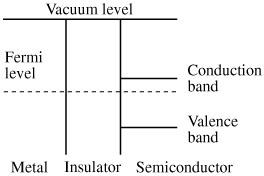
What does the energy diagram look like? For simplicity we shall assume that the Fermi levels of all three materials coincide before we join them together. The energy diagram then takes the form shown in Fig. 9.21, where the semiconductor is taken as n-type.
Are there any surface states at the semiconductor-insulator interface? In practice there are, but their influence is less important than for metal-semiconductor junctions, so we shall disregard them for the time being.
Let us now apply a positive voltage to the metal as shown in Fig. 9.22(a). Will a current flow? No, there can be no current through the insulator. The electrons will nevertheless respond to the arising electric field by moving towards the insulator. That is as far as they can go, so they will accumulate in front of the insulator. Their distribution will be something like that shown in Fig. 9.22(b), where N en is the equilibrium concentration in the bulk semiconductor, and x is the distance away from the insulator. The shape of the curve may...