Electrical Properties Of Materials, Seventh Edition

Junctions between metals and semiconductors had been used in radio engineering for many years before the distinction between p- and n-type semiconductors was appreciated. Your great grandfathers probably played about with 'cat's whiskers' in their early 'crystal sets', as radios were then called, stressing the importance of the piece of coal or whatever was used as the semiconductor detector.
The behaviour of metal-semiconductor junctions is more varied to describe than that of p-n junctions. We find that there is different behaviour on the one hand, with p- and n-type semiconductors, than on the other, when the metal work function is greater or less than that of the semiconductor.
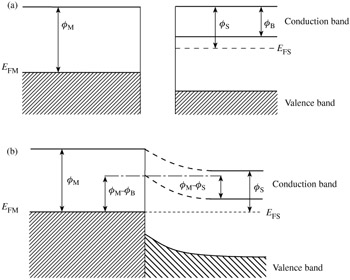
We shall first consider the case of an n-type semiconductor in contact with a metal, whose work function is greater than that of the semiconductor. The semiconductor work function ( ? S in Fig. 9.16) is defined as the energy difference between an electron at the Fermi energy and the vacuum level. The fact that there are usually no electrons at the Fermi energy need not bother us we do not have to explain definitions. Another measure often used is the electron affinity, ? B.
The band structure of the two substances is shown in Fig. 9.16(a). When...