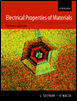
Electrical Properties Of Materials, Seventh Edition
The range of materials suitable for producing various electronic devices has been steadily increasing. It is no great surprise that organic materials have also put in a claim to be represented. They were never completely disregarded, but having reached prominence in the last few years (writing in 2003), they can no longer be ignored. It may indeed be argued that attempts to produce organic light sources are bound to succeed. After all, it has been known a long time that fireflies glow fairly brightly by a process called bio-luminescence. Enzymes in the fly cause reactions that excite organic molecules. When they revert to their ground state, light is emitted, with a very high quantum efficiency, but of course, not much power.
As far as this book is concerned the main problem is that organic chemists and engineers use different technologies and talk a different language. Electrical conduction (or semiconduction) in an organic material is explained by chemists in terms quite different from that of an engineer. They prefer to look at the individual rather than at the crowd. They regard the properties of the individual molecules as paramount and will maintain that the properties of the solid follow from there. It would have been therefore difficult to treat the properties of organics alongside inorganic materials. The best solution seems to be to devote a separate section to them in which the technology and applications follow immediately after the principles.
Some properties of organic materials have though...