Electromagnetic Field Theory Fundamentals, Second Edition
Most of the quantities encountered in electromagnetic fields can easily be divided into two classes, scalars and vectors.
A physical quantity that can be completely described by its magnitude is called a scalar. Some examples of scalar quantities are mass, time, temperature, work, and electric charge. Each of these quantities is completely describable by a single number. A temperature of 20 C, a mass of 100 grams, and a charge of 0.5 coulomb are examples of scalars. In fact, all real numbers are scalars.
A physical quantity having a magnitude as well as a direction is called a vector. Force, velocity, torque, electric field, and acceleration are vector quantities.
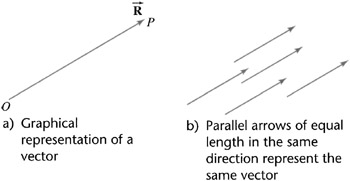
A vector quantity is graphically depicted by a line segment equal to its magnitude according to a convenient scale, and the direction is indicated by means of an arrow, as shown in Figure 2.1a. We will represent a vector by placing an arrow over the letter. Thus, in Figure 2.1a,
represents a vector directed from point O toward point P. Figure 2.1b shows a few parallel vectors having the same length and direction; they all represent the same vector. Two vectors
and
are equal; i.e.,
=
, if they have the same magnitude (length) and direction. We can only compare vectors if they have the same physical or geometrical meaning and hence the same dimensions.
A vector of magnitude zero is called...