Electromagnetic Field Theory Fundamentals, Second Edition

2.3: Vector Operations

2.3 Vector Operations

Adding, subtracting, multiplying, and/or dividing scalar quantities is second nature to most of us. For example, if we want to add two scalars having the same units, we just add their magnitudes. The process of addition in terms of vectors is not this simple, nor are subtraction and multiplication of two vectors. Note that vector division is not defined.

2.3.1 Vector addition

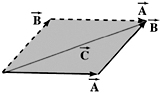
To add two vectors and we draw two representative vectors and in such a way that the initial point (tail) of coincides with the final point (tip) of , as illustrated by the solid lines in Figure 2.2. The line joining the tail of to the tip of represents a vector , which is the sum of the two vectors and . That is,


The sum of two vectors is therefore a vector. We could have drawn first and then , as shown by the dotted lines in Figure 2.2. It is evident that vector addition is independent of the order in which the vectors are added. In other words, the vectors obey the commutative law of addition. That is,


Figure 2.2 also provides the geometric interpretation of vector addition. If and are the two sides of a parallelogram, then is its diagonal. We can also show that vectors obey the associative law of addition. In other words,


Figure 2.2: Vector addition: = +

2.3.2 Vector subtraction

If

UNLIMITED FREE
ACCESS
TO THE WORLD'S BEST IDEAS

SUBMIT
Already a GlobalSpec user? Log in.

This is embarrasing...

An error occurred while processing the form. Please try again in a few minutes.

Customize Your GlobalSpec Experience

Category: Graphics Software
Finish!
Privacy Policy

This is embarrasing...

An error occurred while processing the form. Please try again in a few minutes.