Electromagnetic Field Theory Fundamentals, Second Edition

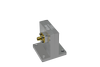
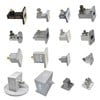
In our discussion of transmission lines, we pointed out that the resistance of a conductor increases with an increase in the signal frequency, leading to an increase in power loss along the line. This power loss becomes intolerable at microwave frequencies (in the GHz range) and makes the transmission line almost impractical. At such high frequencies hollow conductors, known as waveguides, are employed to guide electrical signals efficiently. Figure 10.1 shows a typical waveguide assembly.
In the study of transmission lines with at least two conductors, we found that the propagating wave has field components in the transverse direction and is referred to as the transverse electromagnetic (TEM) wave. However, as a waveguide consists of only one hollow conductor, we do not expect it to support the TEM wave. In this chapter, we show that a waveguide can support the other two types of waves, the transverse magnetic (TM) and the transverse electric (TE) waves. These waves can exist inside a hollow conductor under certain conditions. TM and TE waves can also propagate in a region bounded by a parallel-plate transmission line, in which case the two conducting plates are said to form a parallel-plate waveguide.
The propagation of an electromagnetic wave inside a waveguide is quite different than the propagation of a TEM wave. When a wave is introduced at one end of the waveguide, it is reflected from the wall of...