Electromagnetic Field Theory Fundamentals, Second Edition

2.4: The Coordinate Systems

2.4 The Coordinate Systems

Up to this point we have kept our discussion quite general and used graphical representations when manipulating vectors. From a mathematical point of view it is very convenient to work with vectors when they are resolved into components along three mutually orthogonal (perpendicular) directions. In this text, we will mainly use three orthogonal coordinate systems: the rectangular (or Cartesian) coordinate system, the cylindrical (circular) coordinate system, and the spherical coordinate system. We shall now digress to discuss each of these coordinate systems and then resume our discussion of vectors.

2.4.1 Rectangular coordinate system

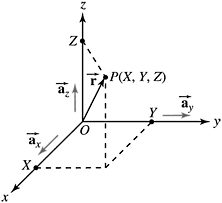
A rectangular (Cartesian) coordinate system is a system formed by three mutually orthogonal straight lines. The three straight lines are called the x, y, and z axes. The point of intersection of these axes is the origin. We will use the unit vectors x, y, and z to indicate the directions of the components of a vector along the x, y, and z axes, respectively.

A point P( X, Y, Z) in space can be uniquely defined by its projections on the three axes as illustrated in Figure 2.8. The position vector , a vector directed from the origin O to point P, can be expressed in terms of its components as


where X, Y, and Z are the scalar projections of on the x, y, and z axes.


Figure...

UNLIMITED FREE
ACCESS
TO THE WORLD'S BEST IDEAS

SUBMIT
Already a GlobalSpec user? Log in.

This is embarrasing...

An error occurred while processing the form. Please try again in a few minutes.

Customize Your GlobalSpec Experience

Category: CMM, Gage, and Inspection Equipment Services
Finish!
Privacy Policy

This is embarrasing...

An error occurred while processing the form. Please try again in a few minutes.