Electromagnetic Field Theory Fundamentals, Second Edition

We often express the basic laws of electromagnetic fields in terms of integrals of field quantities over various curves (lines), surfaces, and volumes in a region. For example, in Chapter 3, we will define the potential function in terms of the line integral of electric field intensity.
In Chapter 4, we will define the current through a conductor as the surface integral of volume current density. A clear understanding of such spatial integrals is essential for our investigation of electromagnetic field theory. In addition, from time to time we will express our final result in integral form to shed some light on its significance. Therefore, let us make a short digression to discuss the concepts of line, surface, and volume integrals.
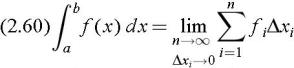
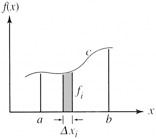
Let f( x) be a continuous, single-valued function of x between the limits x = a and x = b, as shown in Figure 2.21. To define the line integral of f( x), we divide the interval from a to b into n small segments, all of which approach zero in the limit. The line integral is then defined in terms of the limit of the sum as
where f i is the value of f( x) for the segment ?x i such that ?x i ? 0.
We can now extend this definition of...