Electromagnetic Field Theory Fundamentals, Second Edition

In our study of electromagnetism we will often be required to perform line, surface, and volume integrations. The evaluation of these integrals in a particular coordinate system requires the knowledge of differential elements of length, surface, and volume. In the following subsections we describe how these differential elements are constructed in each coordinate system.
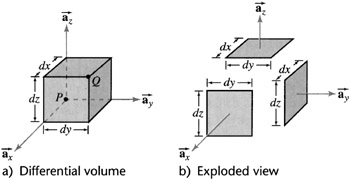
A differential volume element in the rectangular coordinate system is generated by making differential changes dx, dy, and dz along the unit vectors
x,
y and
z, respectively, as illustrated in Figure 2.18a. The differential volume is given by the expression
The volume is enclosed by six differential surfaces. Each surface is defined by a unit vector normal to that surface. Thus, we can express the differential surfaces in the direction of positive unit vectors (see Figure 2.18b) as
The general differential length element from P to Q is
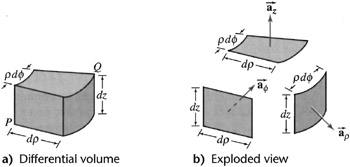
Figure 2.19a shows the differential volume bounded by the surfaces at ?, ? + d ?,
,
+ d
, z, and z + dz. The differential volume enclosed is
The differential surfaces in the positive direction of the unit vectors (Fig. 2.19b) are
The differential length vector from P to Q is