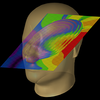
Electromagnetic Field Theory Fundamentals, Second Edition

Chapter 12: Computer-Aided Analysis of Electromagnetic Fields

12.1 Introduction

The evaluation of the electric and magnetic fields in an electromagnetic system is of utmost importance for its efficient design. For example, in an insulating material, to isolate conductors from each other in a system, we want to keep the intensity of the electric fields below the breakdown strength of the insulating medium. In a magnetic switch, the magnetic field intensity should produce a sufficient force to activate the switch. And for the efficient design of a transmitting system, such as an antenna, knowledge of the electromagnetic field distribution in the medium surrounding the antenna is obviously essential.

To analyze electromagnetic fields, we start with the mathematical formulation of the problem. Depending on the nature of the electromagnetic system, Laplace s or Poisson s equation may be suitable to model the system for static and quasistatic (low-frequency) operating conditions. However, in high-frequency applications we must solve the wave equation in either the time domain or the frequency domain to accurately predict the electric and magnetic fields. In any case, the solution of one or more partial differential equations subject to boundary conditions is needed in order to determine the electric and magnetic fields inside and around an electromagnetic system.

Analytical solutions are available only for problems of regular geometry (rectangular, circular, etc.) with the most simple boundary conditions. In the preceding chapters solutions were given for several such configurations using analytical methods.

In this chapter, we will study three numerical techniques to compute electric and magnetic fields: the finite-difference method...

UNLIMITED FREE
ACCESS
TO THE WORLD'S BEST IDEAS

SUBMIT
Already a GlobalSpec user? Log in.

This is embarrasing...

An error occurred while processing the form. Please try again in a few minutes.

Customize Your GlobalSpec Experience

Category: Finite-difference time-domain (FDTD) Software
Finish!
Privacy Policy

This is embarrasing...

An error occurred while processing the form. Please try again in a few minutes.