Electronic Failure Analysis Handbook: Techniques and Applications for Electronic and Electrical Packages, Components, and Assemblies
George Slenski
Air Force Wright Laboratory
Wright-Patterson Air Force Base
Donald Galler
Department of Materials Science and Engineering
Massachusetts Institute of Technology
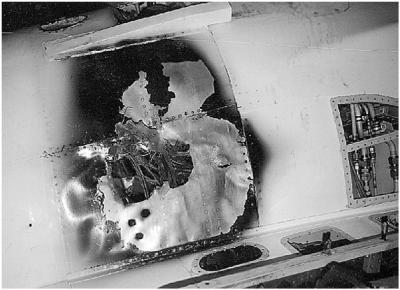
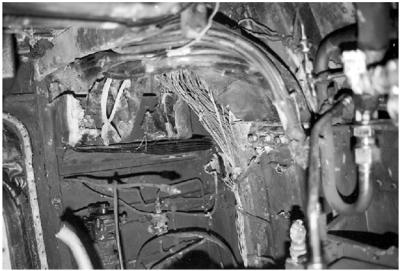
The increased emphasis and reliance on electronic systems for modern aircraft have resulted in wiring becoming a critical safety-of-flight system. Aircraft now routinely use fly-by-wire systems with minimal or no mechanical backup systems. A recent study initiated by the Materials Directorate reported that 34 percent of all aircraft mishaps related to electrical systems were caused by interconnection failures involving wiring and connectors.1 Wiring failures have been found to initiate hydraulic and fuel fires by electrical arcing or cause malfunctions in flight control systems and in other critical areas. At high operating temperatures, some insulations can soften or crack and become susceptible to chafing damage that normally would not occur at room temperature. Examples where wire chafing led to arcing, a fire, and an aircraft mishap are shown in Figs. 15.1 and 15.2.
This chapter discusses current wire constructions, basic materials properties, wiring failure mechanisms, analysis techniques, and case studies. A variety of wire insulations and conductors are used in electronic applications. The discussions in this chapter focus on high-performance products typically associated with aerospace and high-reliability applications. However, many of the topics are applicable to all wire products.
Aircraft...