Electronic Failure Analysis Handbook: Techniques and Applications for Electronic and Electrical Packages, Components, and Assemblies
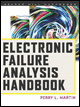
Chapter 20: POWER AND HIGH-VOLTAGE CONSIDERATIONS

Perry L. Martin

National Technical Systems (NTS)

William G. Dunbar

Consultant

20.1 INTRODUCTION

In earlier chapters of this handbook, the reader was introduced to some of the various stresses that drive electronic and electrical equipment to failure, and by now the reader is familiar with the many various techniques for ferreting out information about low-voltage failures that often have insignificant or no visual trace. Failure of power and high-voltage equipment almost often leaves evidence, consisting of a large blackened area, that can appear intimidating to the inexperienced investigator charged with finding the reason for failure. The authors have read many reports that simply announce that the failure occurred either by an arc between adjacent parts or between a part and ground. Can the objective of the failure analysis, which is to prevent failures, be achieved with this type of analysis?

Failure analysis requires a multidisciplinary approach, and the failure analysis techniques that should be employed will depend on the skill and training of the assigned personnel, the equipment available to them for the analysis, and when in the product life cycle the analysis is done. It must be realized that each piece of power or high-voltage equipment is a composite of many electrical and structural parts. Each part has an aging characteristic that is unique to the design and utility of the part and will fail based on a schedule determined by the design, materials, parts, workmanship, environment, and maintenance program associated with the equipment.

This chapter presents some...

UNLIMITED FREE
ACCESS
TO THE WORLD'S BEST IDEAS

SUBMIT
Already a GlobalSpec user? Log in.

This is embarrasing...

An error occurred while processing the form. Please try again in a few minutes.

Customize Your GlobalSpec Experience

Category: Failure Mode and Effects Analysis (FMEA) Software
Finish!
Privacy Policy

This is embarrasing...

An error occurred while processing the form. Please try again in a few minutes.