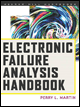
Electronic Failure Analysis Handbook: Techniques and Applications for Electronic and Electrical Packages, Components, and Assemblies
Donald Galler
Department of Materials Science and Engineering
Massachusetts Institute of Technology
Richard A. Blanchard
Duncan Glover
Alexander Kusko
John D. Loud
Noshirwan K. Medora
Gregory J. Mimmack
G nter M ller
E x ponent
This chapter discusses the methodology for determining the root cause of component failures that occur in circuits and systems. This subject is approached by first discussing the physical features and electrical characteristics that can be observed when examining failed components. The physical features, in conjunction with the electrical characteristics, can provide significant information about the specific root cause of the failure. A general approach for determining the physical features and electrical characteristics of components is discussed in the first section, along with the technique that can be used to obtain this information. Subsequent sections discuss the failures that occur for in the various components encountered in contemporary circuits and systems.
The physical features and electrical characteristics of a failed component may provide the only information about the specific root cause of the failure. This section discusses these two critical sets of information about failed devices.
Overvoltage. Overvoltage refers to the presence of a voltage sufficiently high to damage or destroy a device by causing it to operate outside its allowed voltage range. Short-duration overvoltage events can cause device failures and usually result in some observable physical damage. Overvoltage conditions can be caused by a number of events that are external to the device in question. Some of the most...