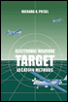
Electronic Warfare Target Location Methods
Chapter 1: Introduction to Emitter Geolocation

Overview

Determining the location of an emitting target is one of the fundamental functions of communication electronic warfare (EW) systems. Knowing the location of targets is useful for several purposes. First, knowing the location of targets indicates the disposition of forces. Second, precision location of targets allows for use of global positioning system (GPS)-enabled fire-and-forget munitions for negation of the target. Third, clustering different types of emitters in the same region can give an indication of the type of entity at a particular location.

This monograph presents several modern (and some not-so-modern) techniques for computing the position fix (PF) of a target based on differing information available from measurements performed on intercepted signals.

The azimuth angle of arrival of a signal, or its line of bearing (LOB), is a frequently used parameter for PF computation. Two or more LOBs, assumed to be measured on the same target at more or less the same time, may intersect as illustrated in Figure 1.1. Such a technique for PF determination is referred to as triangulation. Triangulation is discussed at length in Chapter 2, where several different algorithms are presented.


Figure 1.1: Intersection of measured LOBs.

Another possibility is to measure the time of arrival (TOA) of the signal at several sensors. The TOA itself can be used to compute the PF, where the isocontours are circles, but more typically the TOAs are transferred to a central site where the time differences of arrival (TDOA) are computed...

UNLIMITED FREE
ACCESS
TO THE WORLD'S BEST IDEAS

SUBMIT
Already a GlobalSpec user? Log in.

This is embarrasing...

An error occurred while processing the form. Please try again in a few minutes.

Customize Your GlobalSpec Experience

Category: Optical Triangulation Position Sensors
Finish!
Privacy Policy

This is embarrasing...

An error occurred while processing the form. Please try again in a few minutes.