Electronic Warfare Target Location Methods

It is possible to track moving targets with bearing-only data (called bearing-only TMA). In TMA it is desirable to determine the location and velocity of a moving target, in general. For a set of instantaneous LOBs, the velocity cannot be determined, which is a special case of TMA the target is not moving.
TMA is based on the scenario illustrated in Figure 2.35. Only two dimensions will be included here for simplicity. The target, located at ( x T , y T), is moving with a constant velocity ( v T x, v T y). The state vector associated with the target at time i is thus
. The sensor state vector is defined similarly as
. The velocity of the sensor is not necessarily constant, so it is therefore a function of t i. The relative target-sensor state vector is given by
| (2.300) | |
The discrete time equation describing this dynamic system is given by
| (2.301) | |
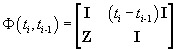
where the state transition matrix is given by
| (2.302) | |
| (2.303) | |
| (2.304) | |
and t i is the ith sample time while t i -1 is the i-1st sample time. The term u( t i) = [0 0 u x( t i) u y( t i)] T in (2.301) accounts for the effects of acceleration of the sensor.
The measurements in this system consist of bearings collected at the sensor referenced to the positive