Electronic Warfare Target Location Methods

A generalization of the LSE estimation technique discussed in Section 2.2 allows for the existence of noise in not only the measurements x k in (2.3), but also for errors in the observation matrix H k. When there is no noise in H k, and the noise represented by n k ~ N(0, ? 2) (this notation means that the noise is normal, or Gaussian, with zero mean and variance ? 2), then the LSE solution
is the same as the maximum likelihood estimate. However, when noise is present in H k, (2.17) with W k = I is no longer optimal. It exhibits bias and increased covariance. To determine the optimal LSE estimate in this case, the method of TLSE estimation was developed [4]. The subscript k will be dropped here for notational convenience.
As described in Section 2.2, the LSE estimate is obtained by finding
by calculating
| (2.38) | |
where ? z ? 2 is the L 2 norm of z. The solution to (2.38) is given by
| (2.39) | |
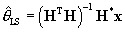
where H is the pseudoinverse of H M P. [1] It is typically assumed that M > P and that H has full rank, so that H = (H *H) -1 H * and
| (2.40) | |
The measurement vector and observation matrix can be expressed as
| (2.41) | |
where ? x