Electronic Warfare Target Location Methods

2.9: Multiple Sample Correlation

2.9 Multiple Sample Correlation

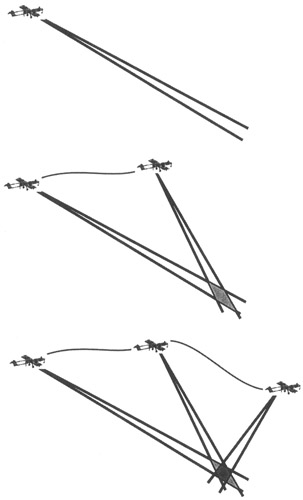
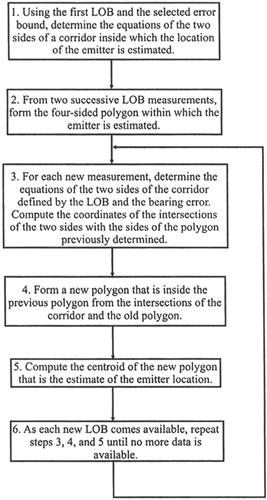
Fu, Vian, and Grose developed an algorithm for position fixing that utilizes the intersection of the LOB fans, defined as the measured LOB plus and minus the maximum error in the sensor [24]. Using the maximum error guarantees that the emitter is within the resulting area. If 1 ? or other statistical quantity is used instead of the maximum error, this guarantee cannot be assumed. However, the EEP can be calculated with a certain probability. The basic idea is illustrated in Figure 2.39. Successive LOBs are obtained from a single sensor or simultaneous LOBs from multiple sensors. The area on the surface of the Earth defined by the sides of these fans is the estimate of the region within which the target lies. The steps in the algorithm are given in Figure 2.40 [24].


Figure 2.39: Multiple sample correlation position fixing.

Figure 2.40: Multiple sample correlation algorithm.

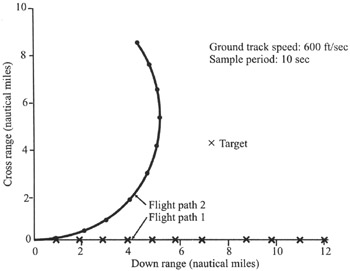
The reference describes a test case, the flight paths of which are shown in Figure 2.41. Two flight paths are described, the first a straight line along the x-axis and the second a curvilinear path with a constant turn rate of 1 per sec. The bearing measurement error was assumed to be 1 .


Figure 2.41: Flight paths for the multiple sample correlation. ( Source: [24], 1988 IEEE. Reprinted with permission.)

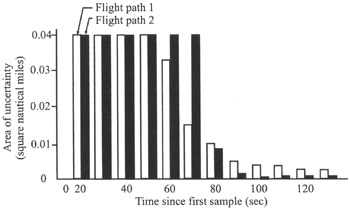
Figure 2.42 illustrates the results. Flight path 2 ultimately yielded more accurate PFs, primarily because of how close to the target the sensor traveled.


Figure...

UNLIMITED FREE
ACCESS
TO THE WORLD'S BEST IDEAS

SUBMIT
Already a GlobalSpec user? Log in.

This is embarrasing...

An error occurred while processing the form. Please try again in a few minutes.

Customize Your GlobalSpec Experience

Category: Sensor Multiplexers
Finish!
Privacy Policy

This is embarrasing...

An error occurred while processing the form. Please try again in a few minutes.