Electronic Warfare Target Location Methods

2.6: The Discrete Probability Density Method

2.6 The Discrete Probability Density Method

All of the position fixing algorithms discussed here are subject to erroneous results due to errors in the data used to compute the fixes. The effects of errors vary. Presented in this section is a technique that mitigates some of the erroneous results when the input data for the fix computations are LOBs [16].

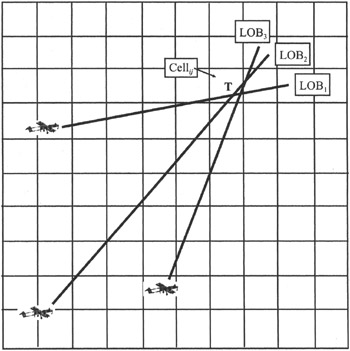
The AOI is segmented into small squares or rectangles with a grid such as the one shown in Figure 2.24. This grid can be as granular as desired/required; however, the smaller the segmentation the higher the computational burden and the higher the resolution (but not necessarily the accuracy). A 100 100 grid requires 100 times the amount of computations of a 10 10 grid, for example.


Figure 2.24: DPD grid with three LOBs.

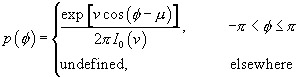
The position-fixing algorithm computes the probability that an emitter lies within each of the grid segments based on the LOBs provided. The LOBs are assumed to have a von Mises pdf (also called the Tikhonov pdf [17]) that is defined over the angular interval (- ?, ?). The Tikhonov pdf is given by [16]

(2.222)

where v is the concentration and indicates the dispersion of ? around ? and is similar to the inverse of the variance of the Gaussian density, ? is the mean of the distribution and, for the purposes here, is the measured LOB, which ranges over (- ?, ?] radians. This function...

UNLIMITED FREE
ACCESS
TO THE WORLD'S BEST IDEAS

SUBMIT
Already a GlobalSpec user? Log in.

This is embarrasing...

An error occurred while processing the form. Please try again in a few minutes.

Customize Your GlobalSpec Experience

Category: Computational Fluid Dynamics Software (CFD)
Finish!
Privacy Policy

This is embarrasing...

An error occurred while processing the form. Please try again in a few minutes.