Electronic Warfare Target Location Methods

An algorithm developed by Brown [5] will be presented in this section for calculating the PF, which is based on minimizing the square of the miss distance of the PF from the measured LOBs. This algorithm was presented in [6] and is included here for completeness
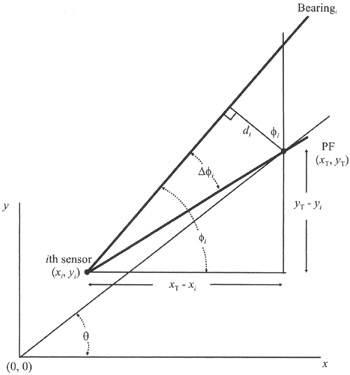
Referring to Figure 2.7, to minimize the sum of the squares of the total miss distance, formulate
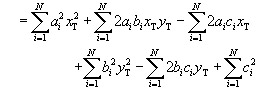
| (2.49) | |
| (2.50) | |
where
| a i = | sin ? i |
| b i = | -cos ? i |
| c i = | x i sin ? i - y i cos ? i |
| N = | number of LOBs |
Setting the first partial derivative of D with respect to x T and then y T equal to zero will find the values of x T and y T for which the total squared distance is minimized.
| (2.51) | |
| (2.52) | |
which yield
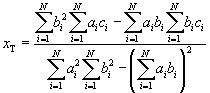
| (2.53) | |
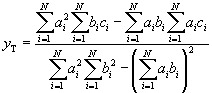
| (2.54) | |
The above miss distance for sensor i is expressed as
| (2.55) | |
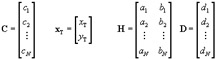
where i is the ith measurement of a line of bearing, and a i, b i, and c i are as given above. In matrix form this is
| (2.56) | |
In this expression,
| (2.57) | |
The LSE estimator for the target location vector x T is given by (2.17) as
| (2.58) | |
where, as usual,...