Designing SOCs with Configured Cores: Unleashing the Tensilica Xtensa and Diamond Cores
1.3: THIRD TIME S A CHARM

1.3 THIRD TIME S A CHARM

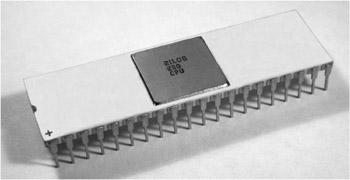
Intel finally got it right in April, 1974 when the company introduced its third microprocessor, the 8-bit 8080. The 8080 microprocessor had a nonmultiplexed bus with separate address and data lines. Its address bus was 16 bits wide, allowing a 64-Kbyte address range. The data bus was 8 bits wide. As shown in Figure 1.5, Intel used a 40-pin DIP to house the 8080 microprocessor. This larger package and the microprocessor s faster 2-MHz clock rate finally brought bus bandwidth up to usable levels. Other microprocessor vendors such as Motorola and Zilog also introduced microprocessors in 40-pin DIPs around this time and system designers finally started to adopt the microprocessor as a key system building block.


Figure 1.5: Intel finally crossed the bus-bandwidth threshold into usability by packaging its third-generation 8080 microprocessor in a 40-pin package. Many competitors swiftly followed suit (shown is Zilog s 8-bit Z80 microprocessor) and the microprocessor quickly became a standard building block for system designers. Photo Courtesy of Stephen A. Emery Jr., www.ChipScapes.com.

UNLIMITED FREE
ACCESS
TO THE WORLD'S BEST IDEAS

SUBMIT
Already a GlobalSpec user? Log in.

This is embarrasing...

An error occurred while processing the form. Please try again in a few minutes.

Customize Your GlobalSpec Experience

Category: Microprocessor Chips (MPU)
Finish!
Privacy Policy

This is embarrasing...

An error occurred while processing the form. Please try again in a few minutes.