Designing SOCs with Configured Cores: Unleashing the Tensilica Xtensa and Diamond Cores

Lacking the access to the high clock rates previously available to PC processor designers, processor core designers must turn to alternative performance-enhancing strategies. Use of additional buses and wider buses are both good performance-enhancing strategies for SOC-centric processor design. In the macro world of packaged microprocessors, additional processor pins incur a real cost. Packages with higher pin counts are more expensive, they re harder to test, and they require more costly sockets. However, in the micro world of SOC design, additional pins for wider buses essentially cost nothing. They do incur some additional routing complexity, which may or may not increase design difficulty. However, once routed, additional pins on a microprocessor core do not add much to the cost of chip manufacture, except for a fractionally larger silicon footprint.
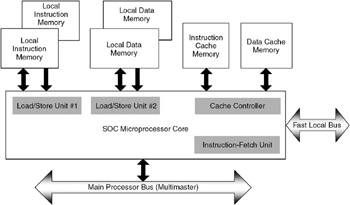
In much the same way, additional microprocessor buses also incur very little cost penalty but provide a significant performance benefit. Processor cores for SOCs often have many more buses than their packaged counterparts, as shown in Figure 1.9.
Figure 1.9 shows a hypothetical processor core with eight buses. One of those buses, the main one, is the traditional multimaster bus that all microprocessors have had since 1971. Four of the buses communicate directly with local data and instruction memories. Two more buses communicate with instruction and data caches, respectively. The remaining bus...